Calm Communication in the Chaos -- Ryan Subject
August 28, 2026
Ryan Subject, AVC 2027, travelled to Port Hope Simpson as one of the student participants on the Chinook Project. As part of the experience, the students craft various pieces of writing.
I am so grateful to have been a part of the 2026 Chinook Project. Out of all my experience in veterinary medicine, I have never learned so much or developed so many new skills in such a short period of time as I did during the Chinook Project. The Chinook Project was truly a life-changing experience. It taught me so much within just a couple of days. My proficiency in the field grew so quickly due to the high-volume, fast-paced nature of the Chinook Project. The first day of clinics started off chaotic, but with the right support and teamwork, it quickly turned into a well-oiled machine. I was surprised by how fast everyone caught on- because the Chinook Project certainly isn't what we are used to at the Atlantic Veterinary College (AVC)
During the Chinook Project, we had a conveyor belt of surgical and medical appointments, and sometimes you never knew what you were going to get. We had minimal anesthetic monitoring equipment, forcing us to rely on our eyes, ears, and intuition while performing anesthesia. We were limited in terms of medications and diagnostics, so we used what we had learned in school and got creative in practice. We were definitely operating in the grey zone—pun intended—as we did not even have a surgical lamp.
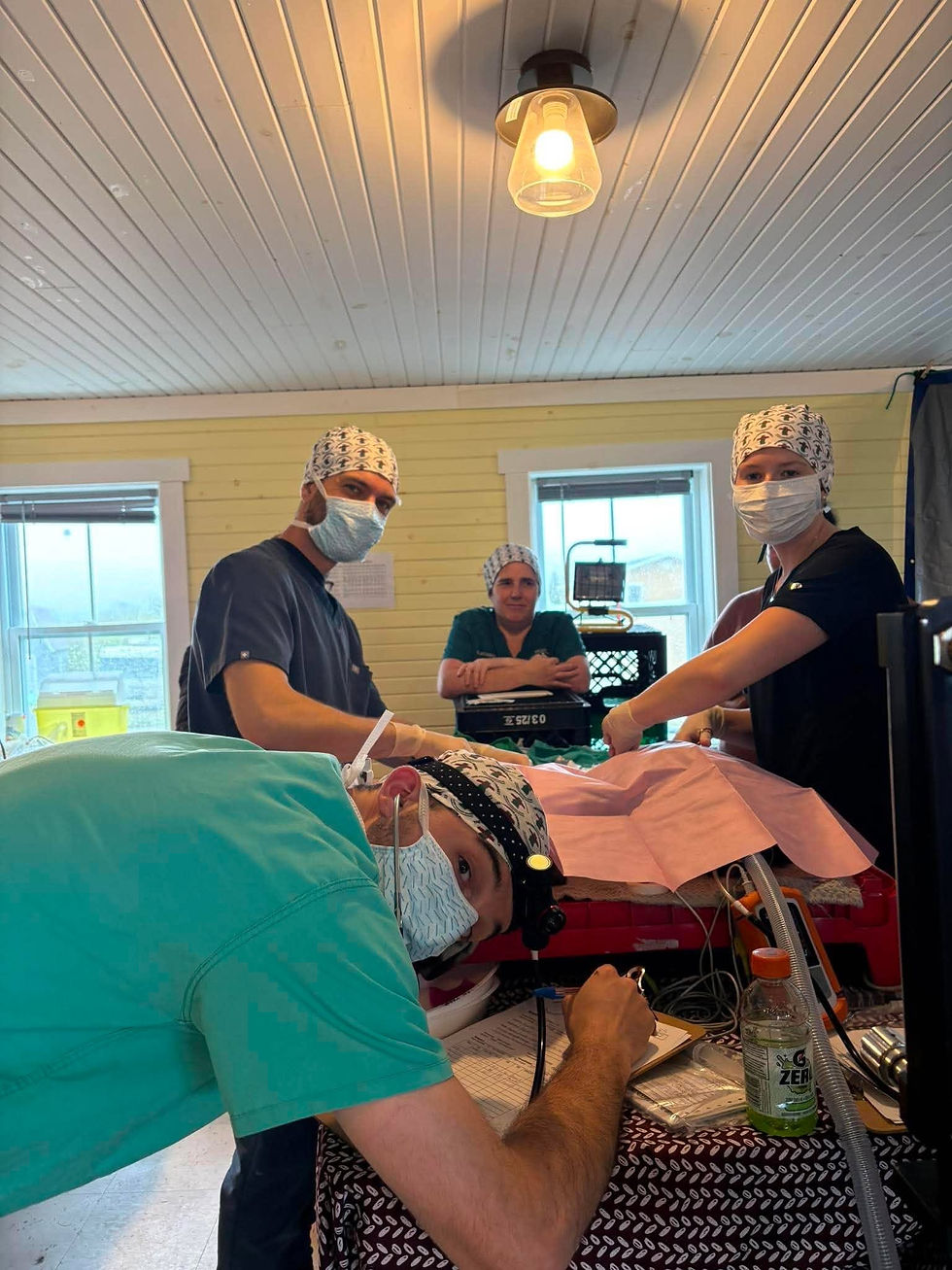
Surgeries were definitely different. We operated on makeshift surgical tables: folding tables zip-tied to milk crates, with a bread crate on top for the taller individuals. For light, we had headlamps and floodlights that never pointed at the right angle. Not to mention, the whole clinic was held in a museum, Port Hope Simpson's oldest building. There was a point in time where I was castrating a dog and my teammate was castrating the dog's littermate on the same table, while another teammate was monitoring anesthesia for both patients. All this was happening while medical appointments were being held, community members were watching, and other patients were being prepped for surgery as soon as a table became free—a very high-traffic and fast-paced environment. For these reasons, it was vital to become efficient at performing surgeries, pay close attention to sterility, and stay calm and confident in times of doubt. The more cases I performed, the faster I became at suturing and ligations, which were tasks that I found very time-consuming prior to the trip. I even picked up some new solo techniques from my leaders and peers.
As for sterility, I found that the traffic around me and the community members watching posed a challenge. It was essential to be aware of my surroundings and my sterile field to protect my patient from any aseptic breaks. Moreover, I am only human, and mistakes happen. Yes indeed, I dropped a pedicle for the first time (blood vessels going to the ovary, causing some bleeding). My first ligature (suture knot) cut through the ovarian pedicle like butter causing it to break and ooze blood. Looking back, I was proud of how I handled it. I immediately took a deep breath and assertively asked for assistance in a calm manner as I extended my incision. By the time the supervising veterinarian got scrubbed in, I had already located the bleeding blood vessel. I achieved this by applying pressure and occasionally having a look while waiting for her to guide me on the next step. It is the challenges you face that teach you the most, and they help build your skills as a professional.

I learned so many skills through my experience. One skill that I had to rely on and that was utilized in every scenario I have described was communication. From taking on medical appointments, running anesthesia, and performing solo surgeries at such a high volume, I would not have learned so much without excellent communication. Communication is the most essential skill during clinics; it is what steered the team. It was vital for patient flow and organization. It is what helped clients to understand and what made them feel heard. Ultimately, communication is the most important skill that I will take away from my experience with the Chinook Project. Communication is the skill that will shape me as a professional, and I am forever grateful for the Chinook Project for that and for all the other things it has taught me.


Comments